WASHINGTON D.C.
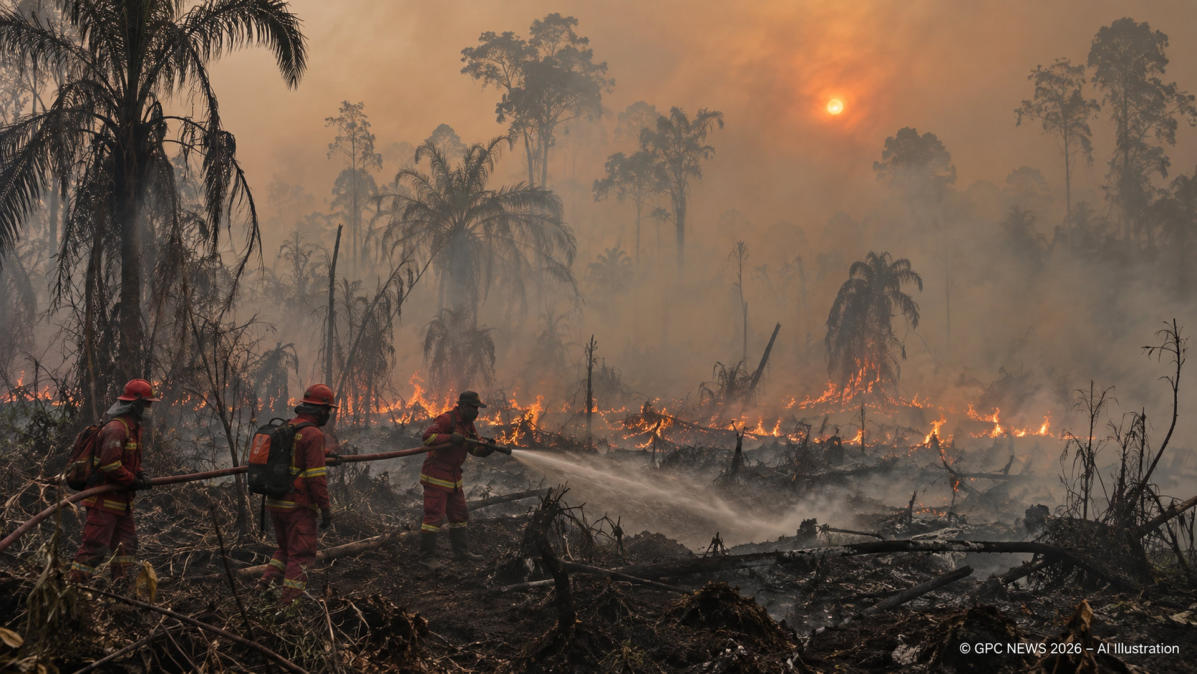
Global Press Connect provides independent news and analysis on international  politics, the economy, and humanitarian developments. © 2026 GlobalPressConnect | GPC.NEWS Founded and operated by Simone Mayer & Helping Hands for Children Foundation Inc. | Los Angeles, California, USA GlobalPressConnect (GPC.NEWS) is an independent international news organization dedicated to delivering accurate, impartial, and timely journalism. Our mission is to provide verified reporting, editorial integrity, and in-depth coverage of global affairs, politics, business, financial markets, technology & AI, entertainment, humanitarian issues, weather, and breaking news. All Rights Reserved. INDONESIAN WILDFIRE EMISSIONS SURGE TO WORLD’S HIGHEST    JAKARTA, September 9, 2026 — Indonesia produced more wildfire-related carbon emissions than any other country during the first week of September as severe drought and extreme heat drove fires across Sumatra and Indonesian Borneo. Satellite-based estimates indicate that fires released approximately 19.7 million metric tons of carbon dioxide between September 1 and September 7. That was more than ten times the estimated emissions from fires in Russia during the same period and approximately 273 percent above Indonesia’s seasonal average. The most heavily affected areas include the provinces of West Kalimantan on Borneo and several parts of Sumatra, where fires have spread through forests, agricultural land and carbon-rich peatlands. Air quality in the West Kalimantan capital of Pontianak reached hazardous levels, with the air-quality index reportedly climbing to 394. At such concentrations, health authorities generally advise residents to remain indoors, close windows and avoid strenuous outdoor activity. Children, older residents and people with heart or respiratory conditions are particularly vulnerable to the microscopic particles contained in wildfire smoke. Prolonged exposure can increase the risk of asthma attacks, respiratory infections and cardiovascular complications.  A powerful El Niño weather pattern has brought unusually dry and hot conditions to parts of Southeast Asia. The lack of rainfall has left vegetation highly combustible and lowered water levels in peatlands, allowing fires to spread beneath the surface. Peat fires are especially difficult to control because they can continue smoldering underground for weeks. They also release enormous amounts of stored carbon and can escape detection by satellites when thick smoke obscures the ground. More than 13,400 fire hotspots were identified across Indonesia between August 1 and September 8. The total has already surpassed the number recorded during the same period in 2015, when a catastrophic fire season created a regional public-health and environmental crisis. Environmental organizations estimate that the amount of land burned during August could eventually reach 600,000 hectares as satellite observations and field reports are updated. Authorities have warned that emissions may continue rising through October if dry conditions persist. Indonesia’s environment ministry said it is monitoring the situation and coordinating fire-control operations. Firefighters, military personnel and local emergency teams have been deployed to vulnerable regions, while aircraft are being used for water bombing and cloud-seeding operations where conditions permit.  Authorities also face renewed scrutiny over fires connected to land clearing. Indonesia has laws prohibiting the burning of forests and peatlands, but enforcement across remote plantation and agricultural regions remains difficult. Smoke from Indonesian fires can travel across national borders, affecting Malaysia, Singapore and other neighboring countries. Regional governments are therefore watching wind patterns and air-quality measurements closely. Indonesia contains some of the world’s largest tropical forests and peat deposits, making the country essential to international efforts to slow climate change. When those ecosystems burn, carbon accumulated over centuries can be released into the atmosphere within days.  The rapidly rising emissions illustrate the connection between extreme weather, land management and climate change. For millions of residents across the region, however, the most immediate threat is the thick smoke now hanging over homes, schools and cities.  © GPC NEWS 2026
GLOBAL